Output is not identity

Behaviour is what your nervous system produces, not who you are
What feels personal is often generated.
State shifts. Conditions change.
And what your nervous system produces changes with them.
The same person can feel calm one moment, reactive the next—
not because they’ve changed, but because something in the nervous system has.
When there’s no space, output happens automatically.
When there is space, something else becomes possible.
This isn’t about fixing behavior.
It’s about understanding where it comes from.
Because when you stop treating output as identity, you stop turning reactions into self-judgment.
And that shift changes how you see everything— yourself, your patterns, and the people around you.
Output is Not Identity

Audio: There is Nothing "Wrong With You"
This audio explores why daily life can start to feel heavier, more effortful, and harder to navigate… even when nothing obvious has changed.
What often gets interpreted as personal failure — inconsistency, overwhelm, withdrawal — may not be who you are, but patterns that formed to help you get through something.
Behaviour is not identity -- it's output
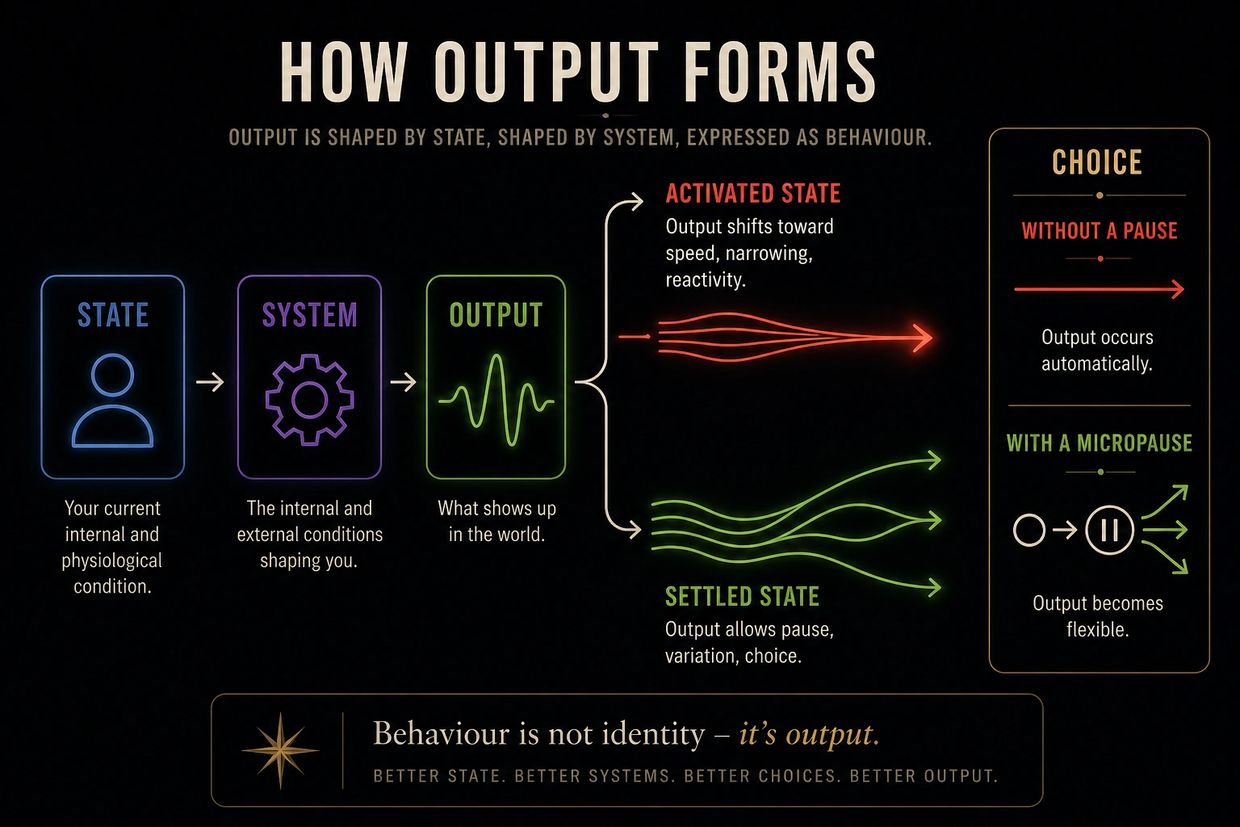
What you see—your reactions, patterns, and habits—doesn’t come from who you are. It comes from the conditions your nervous system is operating under.
Disciplined. Lazy. Reactive. Calm.
As if these are fixed traits.
But behaviour doesn’t start there.
It forms before the story—
as a response to three underlying conditions:
- State — the nervous system’s current activation
- Load — the amount of pressure being carried
- Capacity — how much the system can hold without destabilizing
Together, these shape the signal.
And behaviour is simply the visible expression of that signal.
This diagram shows how different combinations of state, load, and capacity produce different kinds of output.
Not as personality. Not as identity. But as patterns under conditions.
Signal reflects conditions, not character.
When Your Mind Won't Stop
Free Audio Series: Sometimes Our Mind Just Keeps Spinning
This audio series explains what your nervous system is doing -- and what actually helps it settle.
Includes:
1. Why Your Mind Won't Stop
2.Your Nervous System is Scanning
3.Why You Can't Relax on Command
4.Safety is Built Through Predictability
5.Recalibration
Article: The Body Does Not Trust Words

The body does not trust words.
It listens to repetition.
You can say something once—
even say it clearly, confidently, with conviction—
and nothing changes.
Not because the message was wrong.
Because it wasn’t repeated.
The nervous system is not persuaded by language.
It is trained by experience.
A single moment does not mean anything to it.
One calm day does not equal safety.
One good interaction does not rewrite history.
One attempt does not shift a pattern.
The system is not asking:
“Is this true?”
It is asking:
“Does this keep happening?”
This is why people feel stuck.
They do something once—
and expect the response to follow.
When it doesn’t, they assume:
- it didn’t work
- they did it wrong
- or something is wrong with them
But nothing is wrong.
The nervous system is waiting.
Repetition is how the body learns what to expect.
Not intensity.
Not effort.
Not insight.
Repetition.
What happens again and again without harm
begins to register.
What repeats without consequence
starts to feel possible.
What is consistent
becomes familiar.
And what is familiar
is what the nervous system trusts.
Words can point.
But repetition is what proves.
And until something is proven—
the body will hold its position.
Not to resist you.
To protect you.